


AFFORDABILITY: BREAKING FREE OF THE HOUSING TRAP
What Is the Housing Trap?
Over the past couple of decades, a growing contradiction has emerged in the housing market—one that is putting increasing pressure on families and neighborhoods across the country. It’s the tension between housing as an investment asset class and housing as a fundamental human need.
Chuck Marohn, founder of Strong Towns, calls it the Housing Trap.
The Housing Trap is the contradiction between two realities we’re living in at the same time:
- Housing prices need to fall to become more affordable.
- If housing prices fall too much or too fast, many households—and the broader economy—are put at risk.
When prices rise too quickly, people are locked out. When prices fall abruptly, homeowners, lenders, and communities suffer. That tension traps us—unless we change how housing gets built in the first place.
The Current Housing Market
The numbers tell a clear story:
- Housing prices in Sioux Falls have increased roughly 50% in the past five years.
- The share of first-time homebuyers has dropped to a record low of 21%, according to the National Association of Realtors, and the average age of a first-time buyer has climbed to an all-time high of 40.
- We have 8,800 fewer housing units for our current population than the average amount of the developed world, according to the OECD (470 HU per 1,000 persons).
The average home price in Sioux Falls is now $335,526. For a household earning the median income of $74,714, a monthly mortgage would consume:
- 37% of income with a 20% down payment, or
- 46% of income with a minimum down payment.
That’s not affordable by any responsible standard. It leaves families with less money for childcare, food, and transportation options—and makes it harder for young families, seniors, and workers to remain in the city they call home.
How Did We Get Here?
The Housing Trap didn’t appear overnight.
After the 2008 subprime mortgage crisis, the housing industry fundamentally changed. Many small-scale builders folded entirely. Those who survived scaled back on single-family construction and focused instead on multi-family projects in anticipation of growing rental demand. This shift has exacerbated a shortage of starter homes.
Meanwhile, the financial ecosystem that contributed to the housing crash ushered in historically low interest rates, incentivizing homeowners to stay put. Lenders also doubled down on financing single-family homes and large apartment buildings, leaving a broad spectrum of housing in between—often called ‘missing middle’—difficult to finance and therefore difficult to build.
Layered on top of that are zoning and building codes that unintentionally drive up the cost of housing:
- Excessive minimum lot size requirements,
- Lengthy and unpredictable approval processes,
- Regulations that restrict additional housing in established neighborhoods, and
- Parking mandates that result in unnecessary and underutilized spaces.
Individually, these rules may seem reasonable. Collectively, they make it harder—and more expensive—to build the kinds of homes Sioux Falls needs most.
When pent-up demand meets restricted supply in an investment asset class, private equity is sure to follow—driving prices up even further.
There are other contributing factors as well: rising material costs, limited advancement in construction methods, and restrictions on manufactured housing, to name a few. Housing affordability is a complex problem—but the direction of the pressure is clear.
How Do We Escape the Housing Trap?
There is no single silver bullet. But there is a clear path forward that requires a comprehensive approach.
First, we must have realistic expectations for our city. Cities are not not cast in amber—they are ever-changing. Cities also should not be subjected to radical change. That means embracing reform without destabilizing neighborhoods.
What follows is a range of tools we could choose from to address our local housing needs.
Empower Neighborhood Planning
Neighborhoods should not be passive recipients of change—they should be partners in shaping it. Neighborhoods ought to at least discuss the areas they would like to see preserved, and which parts they would like to see evolve.
By empowering neighborhood associations to develop their own visions and plans, we can:
- Encourage incremental development,
- Preserve neighborhood character, and
- Build trust in the planning process.
Local voices matter, and planning works best when it starts at the block level.
Enable Missing Middle Housing
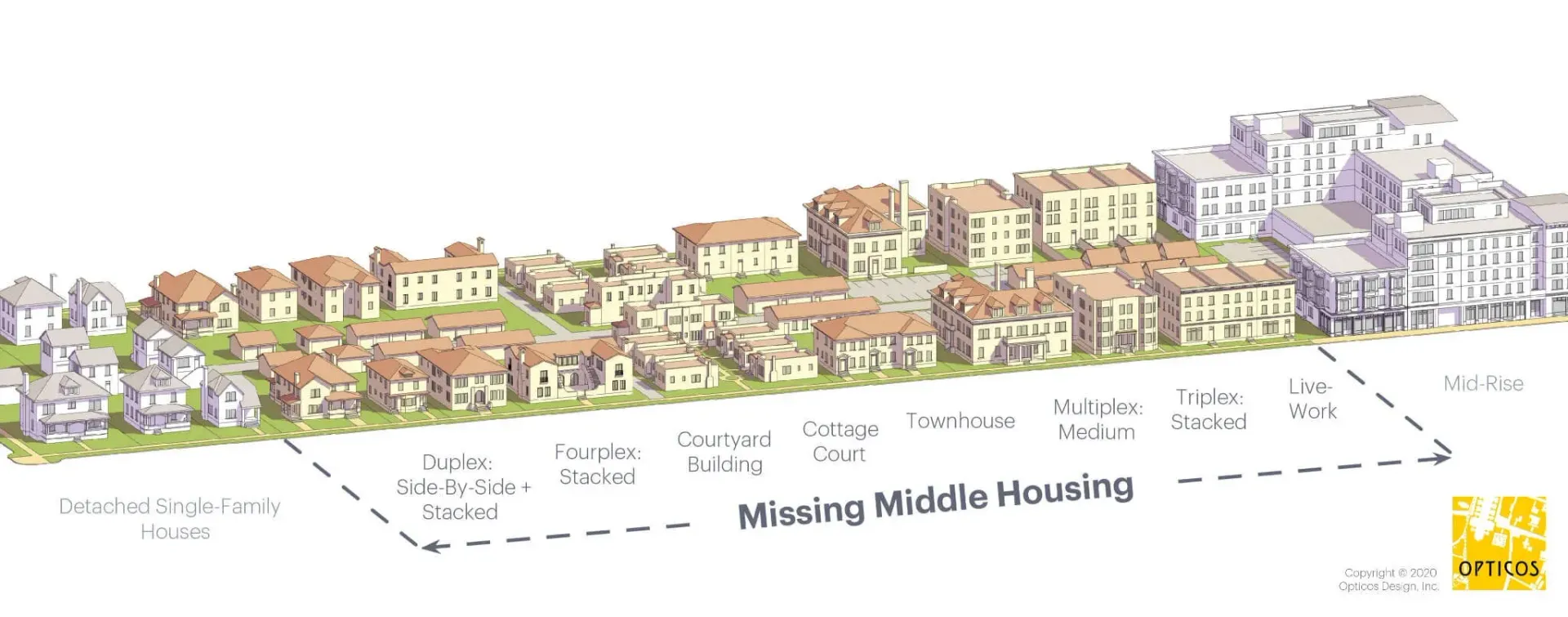
One of the largest gaps in our housing market is missing middle housing—duplexes, fourplexes, courtyard apartments, and small-scale multi-unit buildings that fit comfortably within existing neighborhoods.
To remedy this, we should:
- Include all missing middle housing in the zoning code.
- Create financing tools tailored to these smaller projects.
- Support local builders and developers who specialize in this scale of work.
These homes are often the most attainable, the most flexible, and the most neighborhood-friendly—but under current conditions, they are also the hardest to build.
Updating the Zoning Code
We could target regulations that significantly raise construction costs while providing little or no public benefit. Practical reforms include:
- Relax parking mandates for residential development.
- Remove minimum lot size requirements for single-family housing.
- Streamline approvals so small-scale projects are approved within 48 hours.
These changes won’t transform neighborhoods overnight—but they will allow them to evolve naturally and incrementally.
Preserve Existing Housing
Most housing that qualifies as starter homes is in older neighborhoods. Much of it is at risk of being demolished, however—a trend evident by the many vacant lots in core neighborhoods. Property owners are disincentivized from maintaining and improving their houses under the property tax structure, which often increases taxes when homeowners invest in improvements.
This could be rectified a few different ways:
- Expand the City's revolving fund to rehabilitate distressed properties.
- Allow more tax credits for qualifying improvements for older housing.
- Shift a greater share of property taxes from building values to land values to incentivize improvements.
- Discourage demolition by neglect by proactively enforcing code violations.
- Issue demolition permits only with new building permits for redevelopment projects.
Many Hands Make Light Work
Breaking the Housing Trap doesn’t require massive public spending or risky experiments. It requires nurturing a local ecosystem of small-scale builders, developers, lenders, and neighborhoods working together.
When many hands share the work, we produce more homes, more choices, and more affordability—without sacrificing the character of Sioux Falls.
Housing affordability isn’t just an economic issue. It’s about whether people can put down roots, raise families, and plan for the future in the city they love. If we want Sioux Falls to remain a place where opportunity is within reach, we have to break the Housing Trap—thoughtfully, deliberately, and together as a community.
I can't wait to lead the effort as your next mayor!